
AI Automation for Businesses in Gurugram Where Should You Start by Scriza Pvt. Ltd.
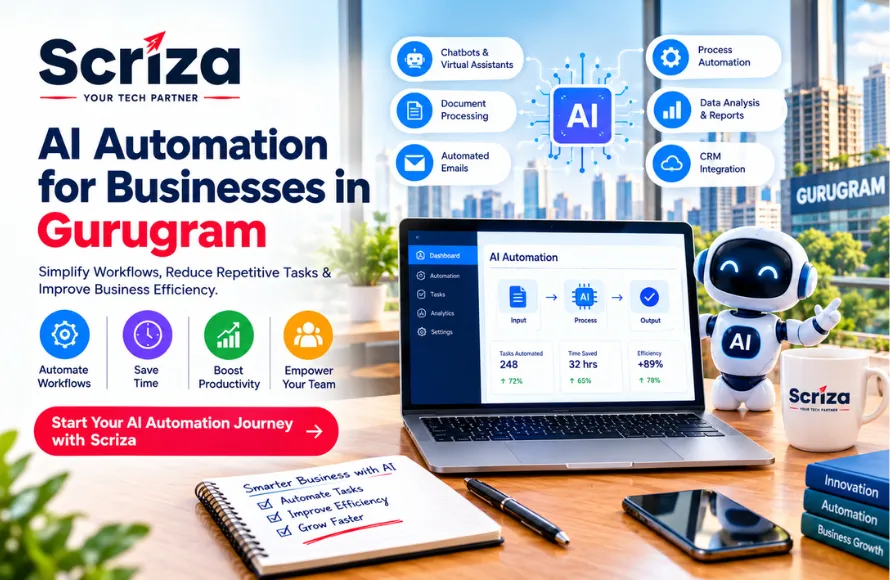
AI automation is becoming part of everyday business conversations. From customer support and sales follow-ups to document processing and internal operations, businesses are looking at AI to reduce repetitive work and make everyday processes easier to manage. But before choosing an AI tool, there is a more important question to answer: Where should you actually start? For a business in Gurugram, the answer does not have to be automating everything at once. A more practical approach is to look at the work your team already does every day, identify repetitive or time-consuming tasks, and then find where automation could make a real difference. AI automation combines artificial intelligence with automated workflows to handle tasks that would otherwise require repeated manual effort. Traditional automation usually follows predefined rules. For example: Customer submits a form - automated email is sent. AI-powered automation can work with more flexible information. For example: Customer sends a message - AI understands the request - identifies the relevant department - prepares a response - updates the system - alerts a team member when human support is required. The right approach depends on the business, its systems, the type of data involved, and how much human involvement the process needs. Gurugram is home to businesses across technology, consulting, healthcare, real estate, finance, education, e-commerce, professional services, and many other industries. Across these sectors, teams often spend considerable time handling: Customer enquiries Emails Documents Sales leads Appointments Internal requests Reports Data entry Follow-ups When the same tasks are repeated every day, automation may be worth exploring. The purpose is not to remove people from every process. Instead, AI automation can take care of suitable repetitive work while employees focus on activities that need judgement, communication, creativity, and decision-making. Before looking for an AI solution, look at your existing workflows. Ask your team: Which tasks are repeated every day? Which activities take up the most time? Where is information entered manually? Which processes involve multiple systems? Where do delays usually happen? Which customer questions come up repeatedly? Which follow-ups are easy to miss? These questions can reveal practical opportunities for automation. For example, if a sales team spends several hours sorting enquiries and sending basic follow-ups, that particular workflow may be a better starting point than trying to automate the entire sales operation. One of the easiest ways to make AI automation unnecessarily complicated is to try implementing it across the entire business at once. Instead, start with one specific workflow. Some possible areas include: AI can help classify incoming enquiries, extract relevant information, update CRM records, and trigger follow-up workflows. AI-powered systems can handle common questions, understand customer intent, and route more complex issues to the appropriate team. AI can extract relevant information from certain documents and transfer it into business systems, reducing repetitive data entry. Automation can help organise reminders, prepare routine messages, and keep lead information updated. Routine employee requests, information searches, notifications, or basic workflow steps can sometimes be automated as well. Starting with one workflow makes it easier to test the idea, identify problems, and understand the actual value before expanding further. AI automation should not be viewed as one isolated task. Consider a typical lead management process: Lead arrives - information is captured - lead is classified - CRM is updated - sales team is notified - follow-up is scheduled - response is tracked. If only one step is automated, employees may still need to manually manage everything around it. That is why it helps to map the complete workflow first. Once you understand how information moves from one step to another, it becomes easier to decide where AI can genuinely help. AI automation becomes more useful when it can work alongside the systems your business already uses. Depending on the organisation, these could include: CRM software ERP systems Websites Customer support platforms Email systems Databases Accounting software Communication tools Internal dashboards Good integrations can reduce duplicate data entry and help information move between systems more smoothly. At the same time, integrations need to be planned carefully so that data remains accurate and access is limited to the people or systems that actually need it. Not every task should be fully automated. Some activities can be handled automatically, while others still need human review. For example: AI can handle: People can handle: This balance allows businesses to benefit from automation without removing human oversight where it matters. AI can support customer communication through chatbots, AI assistants, voice systems, and automated response workflows. But customer-facing automation needs to be designed around the actual customer experience. A useful system should: Understand common requests Provide relevant information Keep conversations focused Know when a human should take over Maintain appropriate records Give customers a clear next step If customers keep getting stuck in an automated system, the technology can create more frustration instead of solving the original problem. AI automation does not always need to be visible to customers. Businesses can also use it to support internal teams with everyday work. Examples include: Summarising documents Organising information Preparing reports Searching internal knowledge Categorising requests Drafting routine communication Extracting information from documents Creating workflow notifications A small improvement can become meaningful when the same task is repeated across a team every day. AI automation may involve customer information, business records, documents, or other sensitive data. Before implementing a workflow, businesses should understand: What data will be used? Where will it be stored? Who will have access? What information should not be shared? How long should data be retained? What security controls are required? Data privacy and security should be part of the planning process from the beginning rather than something considered after the system is already running. Automation should have a clear business objective. Depending on the workflow, useful measurements may include: Time saved Processing time Response time Number of automated tasks Reduction in manual errors Customer response rates Lead follow-up speed Employee productivity Operational costs For example, if an automated workflow saves a team several hours every week while maintaining the required quality, the business has a practical basis for deciding whether to expand automation. There is one principle worth remembering: Do not automate a broken process. If a workflow already has unnecessary steps, unclear responsibilities, duplicate information, or inconsistent data, adding AI may simply automate those problems. Before introducing automation, first understand how the process works and simplify it wherever possible. Then AI can be introduced where it actually adds value. Choosing an AI tool first can result in a solution that looks impressive but does not solve an important business problem. Some processes need human judgement and should remain partly manual. A new AI solution can create additional work if it does not connect properly with the software your team already uses. Automated responses and decisions may still need review, particularly when the situation is sensitive or complex. Saving time is useful, but businesses should also consider quality, customer experience, response time, accuracy, and overall workflow improvement. At Scriza Pvt. Ltd., AI automation starts with understanding the business process rather than simply choosing an AI tool. Depending on the requirement, the process can include identifying repetitive tasks, designing AI-powered workflows, connecting existing systems, and deciding where human involvement is needed. From customer communication and lead management to internal operations and business process automation, the focus is on building practical solutions around the way a business actually works. If you want to understand more about Scriza and its approach to technology and digital solutions, visit the about us page. You can also explore the available Packages to see the services and options offered by Scriza. AI automation does not necessarily require a large transformation project from day one. For many businesses, a practical starting point is one repetitive workflow that already takes up valuable employee time and can be measured clearly. Once that process is understood, businesses can test automation, review the results, improve the workflow, and gradually explore other opportunities. The better question is not: “Where can we use AI?” It is: “Which part of our business could work better if the right tasks were automated?” If you are exploring AI automation for your business in Gurugram, Contact Scriza Pvt. Ltd. to discuss your workflow and identify practical opportunities for automation.What Is AI Automation?
Why Businesses in Gurugram Are Exploring AI Automation
1. Start by Finding Repetitive Work
2. Start With One Workflow
Lead Management
Customer Support
Document Processing
Sales Follow-Ups
Internal Requests
3. Look at the Complete Workflow
4. Connect AI With Your Existing Systems
5. Decide Where Humans Should Stay Involved
Basic classification, information extraction, routine responses, reminders, and workflow triggers.
Sensitive decisions, complex customer issues, approvals, negotiations, exceptions, and situations requiring judgement.6. Be Careful With Customer-Facing AI
7. Use AI for Internal Productivity Too
8. Think About Data Before Implementation
9. Decide How You Will Measure the Results
10. Improve the Process Before Automating It
Common AI Automation Mistakes to Avoid
Starting With Technology Instead of the Problem
Trying to Automate Everything
Ignoring Existing Systems
Forgetting Human Oversight
Measuring Only Cost Savings
How Scriza Can Help With AI Automation in Gurugram
AI Automation Does Not Have to Start With a Big Project
Related News

Performance Marketing Services for Real Estate Businesses in Delhi NCR
9 Oct 2026

Content Marketing for Real Estate Businesses in Ghaziabad
9 Oct 2026

Lead-Focused Website Development for Real Estate Businesses in Noida
9 Oct 2026

Digital Marketing Agency for eCommerce Marketplace Businesses in Delhi NCR
9 Oct 2026

Social Media Marketing for Residential & Commercial Real Estate in Gurugram.
9 Oct 2026
Categories

AI Business Solutionsa
AI Solutions Company in Delhi NCR Helping Businesses Across India Automate, Innovate & Grow

Answer Engine Optimization (AEO)
Professional Answer Engine Optimization (AEO) Services in Delhi NCR for Businesses Across India

E-Commerce Development
Professional eCommerce Development Services in Delhi NCR for Businesses Across India

Generative Engine Optimization (GEO)
Professional Generative Engine Optimization (GEO) Services in Delhi NCR for Businesses Across India

Mobile Application Development
Professional Mobile Application Development Services in Delhi NCR for Businesses Across India

Paid Marketing
Professional Paid Marketing Services in Delhi NCR for Businesses Across India

Search Engine Optimization (SEO)
Professional Search Engine Optimization (SEO) Services in Delhi NCR for Businesses Across India

Software Development
Custom Software Development Services in Delhi NCR for Businesses Across India

Website Development
Professional Website Development Services in Delhi NCR for Businesses Across India

Grow Your Business with Performance Marketing
Commit for 3 months and get 2 video shoots absolutely FREE.