
How Agentic AI Can Change Business Workflows in Delhi NCR by Scriza Pvt. Ltd.
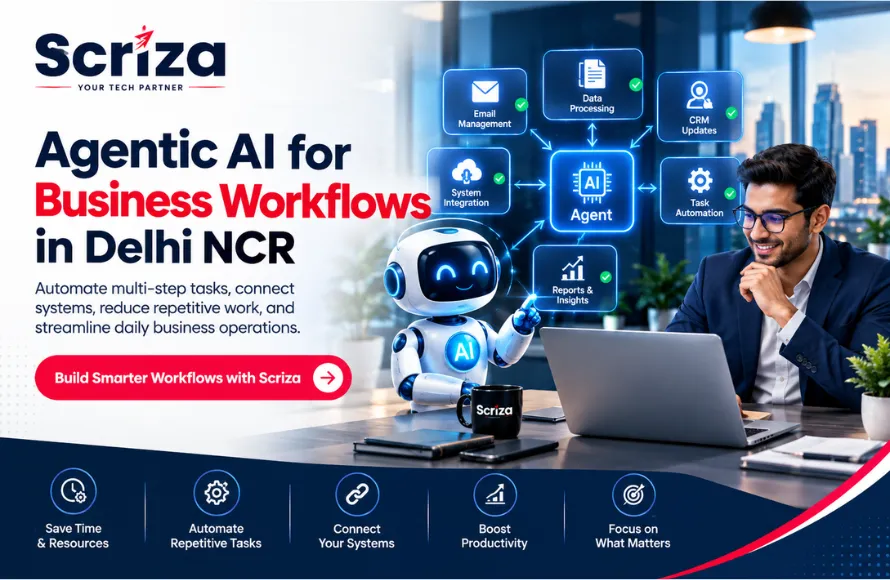
Businesses manage many processes every day, from handling customer enquiries and updating records to preparing reports and coordinating internal tasks. When these activities are handled manually, even simple processes can take considerable time as the business grows. Agentic AI introduces a different way of approaching these workflows. Instead of performing only one predefined action, AI agents can work through a series of connected tasks, use relevant business information, and take the next step according to the situation. For businesses across Delhi NCR, including Noida, Greater Noida, Gurugram, Ghaziabad, Faridabad, and Delhi, this approach can create new opportunities to simplify repetitive work and connect different parts of the business. Traditional automation generally follows a fixed sequence. For example: Form submission → automatic email → CRM update An Agentic AI workflow can involve more steps and adapt to the information available. For example: Customer enquiry → understand the request → check relevant information → classify the enquiry → update the CRM → prepare a response → notify the appropriate employee The difference is not simply about doing more tasks. It is about allowing an AI system to work through a business process while using connected tools and defined instructions. Agentic AI can be considered for workflows where employees repeatedly collect information, make routine updates, move data between systems, or coordinate several steps. Common areas include: Customer enquiries Sales operations Customer support Document processing Internal requests Lead follow-ups Reporting Business administration System-to-system workflows The exact use case depends on the company's existing process, software, data, and requirements. Enquiries can arrive through websites, emails, social media, forms, and other channels. An AI agent can help organise this information and move each enquiry through the appropriate workflow. It may identify what the customer is asking about, collect relevant details, categorise the enquiry, and send it to the appropriate team. This can make enquiry management more organised, especially when teams receive a large number of requests. Sales teams often spend time performing routine activities around leads rather than directly communicating with prospects. An AI-powered workflow can assist with tasks such as: Organising incoming leads Identifying lead requirements Updating CRM records Preparing follow-up messages Setting reminders Notifying sales representatives Tracking pending actions Employees can then review important information and handle conversations that require personal attention. Customer support is another area where multiple systems and steps may be involved. An AI agent can receive a customer request, find information from approved sources, prepare an initial response, create or update a support ticket, and involve a human employee when the issue requires further attention. This creates a more connected support process without expecting AI to handle every customer situation independently. Businesses have plenty of internal requests that can take time when handled manually. Employees may need to find documents, request information, submit routine approvals, check records, or coordinate with different departments. An AI agent can provide an interface through which employees can make these requests and receive information from connected business systems. For example, an employee could ask for a particular report or customer record instead of manually searching through several applications. Documents are an important part of many business operations. Invoices, applications, forms, reports, contracts, and customer documents may need to be reviewed and processed before information reaches another system. Agentic AI can be incorporated into workflows that extract relevant information, classify documents, identify missing details, and send the information to the appropriate next step. Human review can still be included when the information is sensitive or the decision requires approval. Many companies use several software platforms at the same time. A business may have separate tools for: CRM Email Customer support Accounting Inventory HR Project management Communication When these systems are not well connected, employees may spend time transferring information manually. Agentic AI can work as part of an integrated workflow, allowing selected actions to move between connected systems according to predefined permissions and business rules. A missed follow-up can delay a sales opportunity or leave a customer waiting for a response. An AI-powered workflow can monitor specific conditions and trigger the next action when appropriate. For example: New lead → first response → no response → follow-up reminder → update status → notify sales team This type of workflow can reduce the need for employees to remember every routine step manually. Different industries can use Agentic AI in different ways depending on their workflows. AI-powered workflows can support appointment enquiries, reminders, administrative requests, and other routine processes while keeping appropriate human involvement. Schools, colleges, coaching institutes, and training companies can explore AI workflows for admissions, enquiries, student communication, and administration. Real estate businesses can use AI-assisted workflows for property enquiries, lead qualification, follow-ups, scheduling, and customer communication. AI agents can support product-related questions, order communication, customer requests, and selected post-purchase workflows. Consulting, technology, and other service companies can use AI workflows to organise enquiries, documents, internal requests, and repetitive administrative activities. Agentic AI does not have to mean removing people from business processes. In many cases, a better approach is to divide the workflow between AI and employees. For example: AI collects information → AI prepares the task → employee reviews it → employee approves important action → AI completes the approved step This type of human-in-the-loop workflow can be useful when a process involves sensitive information, financial decisions, customer commitments, or other actions that need human approval. Businesses do not need to automate an entire operation at once. A practical starting point is to identify one workflow that creates a clear amount of repetitive work. Look for processes that: Occur frequently Involve several steps Require information from multiple systems Include repetitive data entry Often involve follow-ups Have clearly defined rules Take employees away from higher-value work Once the workflow is identified, the business can determine which steps are suitable for AI and which should remain with employees. Before introducing an AI agent into a business process, several factors should be considered. Identify what information the AI needs and where that information is stored. Determine which CRM, databases, communication tools, or other software need to work with the AI workflow. Define what the AI can view, change, or trigger and which actions require human approval. Decide where employees should check information or approve an action. Track workflow performance and review the results regularly so the process can be improved over time. As businesses grow, the number of enquiries, customers, documents, and internal tasks often increases as well. Adding more manual steps to handle this growth may increase the workload for employees. Agentic AI provides another option: businesses can examine their existing workflows and identify where intelligent automation can take care of repetitive coordination. The value comes from solving a specific operational problem rather than using AI simply because it is a new technology. Every business has its own software, processes, customers, and operational requirements. A useful AI solution therefore needs to be connected to the way the business actually works. Scriza Pvt. Ltd. can help businesses in Delhi NCR explore practical Agentic AI opportunities based on their existing workflows. Our approach can involve: Understanding the current business process Identifying repetitive workflow steps Planning AI-powered automation Connecting relevant business systems Designing human approval points Developing AI agent workflows Monitoring and improving the solution The objective is to create an AI workflow that addresses a real business requirement and fits into the company's existing operations. Agentic AI is changing the way businesses think about automation. Instead of focusing on one isolated task, companies can look at the complete workflow and identify where AI can coordinate multiple activities. For businesses in Delhi NCR, this can create opportunities to reduce repetitive work, improve coordination, and give employees more time for tasks that require human involvement. The best starting point is usually a workflow with a clear problem and measurable outcome. If your business is exploring Agentic AI, Scriza Pvt. Ltd. can help identify suitable workflows and develop AI-powered solutions around your actual business requirements.What Makes Agentic AI Different?
Where Can Agentic AI Help Businesses?
1. Managing Business Enquiries
2. Supporting Sales Teams
3. Improving Customer Service Workflows
4. Simplifying Internal Business Tasks
5. Working With Business Documents
6. Connecting Business Applications
7. Making Follow-Ups More Consistent
Agentic AI Applications Across Delhi NCR Industries
Healthcare Businesses
Education Businesses
Real Estate Companies
E-commerce Businesses
Professional Service Businesses
Agentic AI and Human Collaboration
How Businesses Can Start With Agentic AI
Important Things to Consider Before Implementation
Data and Information
System Connections
Access and Permissions
Human Review
Monitoring and Improvement
Why Agentic AI Can Be Useful for Growing Businesses
Why Choose Scriza for Agentic AI Solutions?
Build Smarter Business Workflows With Agentic AI
Related News
Performance Marketing Services for Real Estate Businesses in Delhi NCR
9 Oct 2026

Content Marketing for Real Estate Businesses in Ghaziabad
9 Oct 2026

Lead-Focused Website Development for Real Estate Businesses in Noida
9 Oct 2026

Digital Marketing Agency for eCommerce Marketplace Businesses in Delhi NCR
9 Oct 2026

Social Media Marketing for Residential & Commercial Real Estate in Gurugram.
9 Oct 2026
Categories

AI Business Solutionsa
AI Solutions Company in Delhi NCR Helping Businesses Across India Automate, Innovate & Grow

Answer Engine Optimization (AEO)
Professional Answer Engine Optimization (AEO) Services in Delhi NCR for Businesses Across India

E-Commerce Development
Professional eCommerce Development Services in Delhi NCR for Businesses Across India

Generative Engine Optimization (GEO)
Professional Generative Engine Optimization (GEO) Services in Delhi NCR for Businesses Across India

Mobile Application Development
Professional Mobile Application Development Services in Delhi NCR for Businesses Across India

Paid Marketing
Professional Paid Marketing Services in Delhi NCR for Businesses Across India

Search Engine Optimization (SEO)
Professional Search Engine Optimization (SEO) Services in Delhi NCR for Businesses Across India

Software Development
Custom Software Development Services in Delhi NCR for Businesses Across India

Website Development
Professional Website Development Services in Delhi NCR for Businesses Across India

Grow Your Business with Performance Marketing
Commit for 3 months and get 2 video shoots absolutely FREE.