
How eCommerce Businesses in Delhi NCR Can Improve Product Discovery with SEO by Scriza Pvt. Ltd.
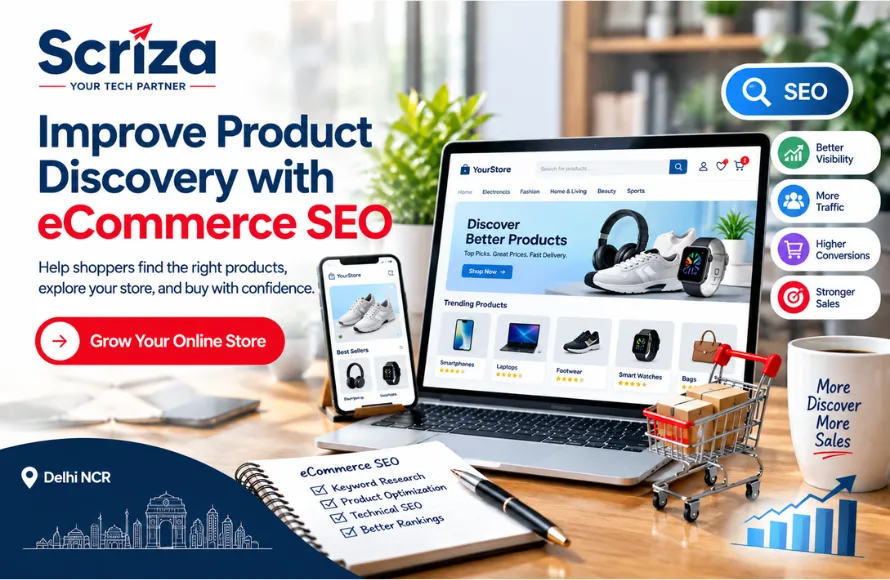
Having hundreds of products on an online store does not mean customers will easily find them.
A shopper may search for a product on Google, browse a category, compare different options, read reviews, and then visit a product page before buying. If your website makes any of these steps difficult, customers may leave before finding what they need.
For eCommerce businesses in Delhi NCR, SEO can help make products easier to discover through search engines and website navigation.
In this guide, we’ll look at practical ways to improve product discovery and create a smoother journey from search to purchase.
What Product Discovery Means in eCommerce
Product discovery is simply how shoppers find products that match their needs.
They may discover products through:
Google search
Category pages
Product pages
Buying guides
Image search
Internal website search
Social media
Product recommendations
The easier it is to find the right product, the easier it becomes for customers to explore your store.
Understand Different Shopping Searches
Customers use different searches depending on where they are in the buying journey.
For example:
Broad: “running shoes”
Specific: “running shoes for beginners”
Feature-based: “lightweight running shoes”
Purchase-focused: “buy lightweight running shoes online”
Brand-focused: “Brand X running shoes”
Make Product Pages More Useful
A product page should answer the questions a shopper may have before buying.
Include useful information such as:
Product name
Key features
Specifications
Price
Variants
Images
Availability
Delivery information
Returns or warranty
Reviews
FAQs
Good product pages help customers understand what they are buying without making them search elsewhere.
Handle Product Variations Carefully
Products often come in different sizes, colours, models, materials, or configurations.
Creating a separate page for every variation can sometimes lead to duplicate or unnecessary URLs. Decide carefully which variations need separate pages and how they should be organized.
The goal is to keep the website simple for shoppers and easy for search engines to understand.
Build Strong Category and Subcategory Relationships
A large online store needs a clear structure.
For example:
Electronics → Laptops → Business Laptops → Product
or
Beauty → Skincare → Face Serums → Product
This structure helps shoppers move from a broad category to the exact product they want.
Don't Ignore Internal Search
Many shoppers use the search box as soon as they enter an eCommerce website.
Check whether your internal search handles:
Search suggestions
Misspellings
Zero-result searches
Product matching
Filters
Popular searches
Your internal search data can also show what customers are actually looking for.
Use Customer Reviews as Useful Content
Reviews can answer questions that a standard product description may miss.
Customers often talk about:
Quality
Size and fit
Performance
Ease of use
Packaging
Real-world experience
Genuine reviews can make product pages more useful and help shoppers make informed decisions.
Create Buying Guides
Not every shopper is ready to buy immediately.
Some need help choosing the right product. Buying guides can answer those questions and connect readers with relevant products.
Examples include:
How to choose the right laptop for work
How to select skincare products
What to consider before buying office furniture
How to choose fitness equipment
Use Comparison Content
Customers often compare products before making a decision.
Comparison content can cover:
Product A vs Product B
Different models
Features
Sizes
Price ranges
Keep comparisons factual and easy to understand so shoppers can make their own decision.
Optimize Product Images
Images are a major part of online shopping. For SEO and user experience, pay attention to: Descriptive filenames Useful alt text Image compression Suitable dimensions Mobile loading speed Good images should help customers understand the product rather than simply decorate the page.
Location pages can be useful for eCommerce businesses serving specific areas, but they should provide real local value. Instead of creating similar pages by simply changing city names, include useful information such as delivery coverage, pickup options, or local availability.
Improve Website Navigation
A large product catalogue needs simple navigation.
Useful features include:
Categories
Filters
Sorting
Breadcrumbs
Search suggestions
Related products
Recently viewed products
The easier it is to move around the website, the easier it is to discover products.
Manage Faceted Navigation Carefully
Filters such as price, brand, size, colour, and rating are helpful for shoppers.
However, combining multiple filters can create a large number of URLs. Technical SEO should determine which filtered pages need search visibility and which should remain out of the index.
Connect SEO With Conversion Optimization
Getting visitors to your website is only one part of the journey.
A customer may find your product through Google but still leave if the page is confusing.
A simple journey should look like:
Search → Product Discovery → Product Page → Trust → Purchase
Clear information, reviews, pricing, delivery details, and easy navigation can all help improve that experience.
Use SEO Data to Understand Customers
SEO data can tell you more than where your website ranks.
It can show:
What products people search for
Which categories attract interest
Which pages get traffic
Which queries generate clicks
Where visitors leave
These insights can help businesses improve their products, content, and website structure.
SEO for eCommerce Businesses Across Delhi NCR
eCommerce businesses serving Delhi NCR may need different SEO approaches depending on their target market and business model. A regional store may focus on local searches, delivery information, and location-based pages, while a wider eCommerce business may focus more on product and category visibility.
How Scriza Pvt. Ltd. Can Help
Scriza Pvt. Ltd. can help eCommerce businesses improve product pages, category structure, technical SEO, content, website navigation, and conversion paths. The approach can be tailored to the business, products, target customers, and existing website.
Build a Better Product Discovery Journey
Good eCommerce SEO should make it easier for customers to find the right products, understand their options, and move towards a purchase.
For businesses in Delhi NCR, a clear website structure, useful content, and well-optimized product pages can create a smoother shopping experience.
Scriza Pvt. Ltd. can help businesses build an eCommerce SEO strategy around their specific products and customer needs.
Related News

Categories

AI Business Solutionsa
AI Solutions Company in Delhi NCR Helping Businesses Across India Automate, Innovate & Grow

Answer Engine Optimization (AEO)
Professional Answer Engine Optimization (AEO) Services in Delhi NCR for Businesses Across India

E-Commerce Development
Professional eCommerce Development Services in Delhi NCR for Businesses Across India

Generative Engine Optimization (GEO)
Professional Generative Engine Optimization (GEO) Services in Delhi NCR for Businesses Across India

Mobile Application Development
Professional Mobile Application Development Services in Delhi NCR for Businesses Across India

Paid Marketing
Professional Paid Marketing Services in Delhi NCR for Businesses Across India

Search Engine Optimization (SEO)
Professional Search Engine Optimization (SEO) Services in Delhi NCR for Businesses Across India

Software Development
Custom Software Development Services in Delhi NCR for Businesses Across India

Website Development
Professional Website Development Services in Delhi NCR for Businesses Across India

Grow Faster This Raksha Bandhan
For a limited time, get 1 month FREE when you choose our 6-month Performance Marketing package. Available exclusively for businesses in Delhi NCR.